Fertility Tracking
How Lady-Comp can support you to get to know your cycle
Every woman is unique and so is her cycle: some cycles are longer, some shorter, and the time of ovulation can also vary. The course of the cycle differs not only from woman to woman, but also from cycle to cycle. Lady-Comp creates your very own profile and adjusts the prognosis based on your cycle history and over 10 million cycles already analyzed.[¹]
The biological background
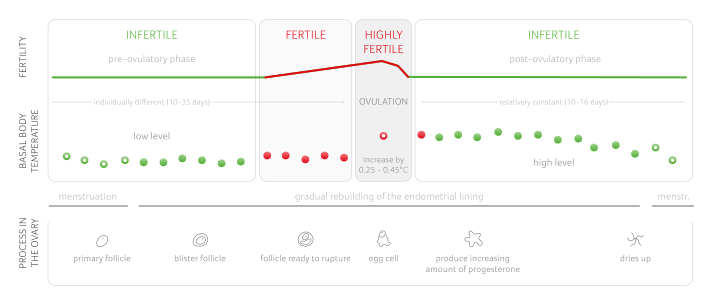
The physiological basis for the measurement of the basal body temperature (BBT), also called waking temperature, is that your body temperature rises slightly around 24 hours after ovulation due to the hormone progesterone[²] and then remains at a constantly high level (about 0.2 °C above the average pre-ovulatory temperature level)[³] until the onset of menstruation. Basal body temperature is used by the Lady-Comp to calculate and confirm when and if you have ovulated. It is measured directly after waking up in the mouth, under the tongue.
- Each woman has only one ovulation per cycle.[⁴]
- If, in rare cases, two or more ovulations occur, they always take place within 24 hours.[⁹]
- After ovulation, the egg can be fertilized for a maximum of 18 hours.
- After sexual intercourse, the sperm can move and fertilize in the woman's body for a maximum of 120 hours (= 5 days).[⁵]
- This means that a pregnancy can only occur on a maximum of six days - five days before ovulation and on the day of ovulation itself.[⁶]
Hormones and temperatures
The hormones estrogen, progesterone, FSH (follicle stimulating hormone), LH (luteinizing hormone), and testosterone play important roles in your cycle. FSH and LH ensure that the egg (ovum) matures. After ovulation, the egg membrane (follicle) transforms into the corpus luteum and produces the hormone, progesterone, which causes your basal body temperature to rise slightly.[²] Estrogen causes the uterine lining to thicken and more cervical mucus to be produced.[⁷]
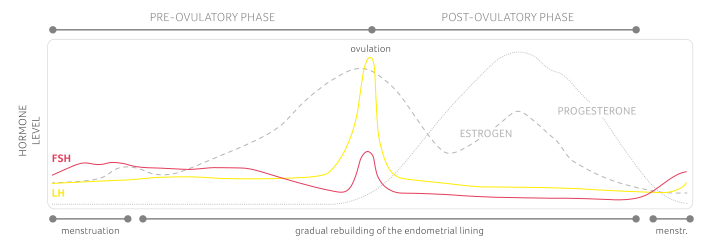
This pattern is used by the cycle computer as the basis for its calculations, filtering out those six days in the cycle during which conception is potentially possible.[⁶]
Cycle calculation for irregular cycles
Cycle fluctuations are normal and a natural part of the menstrual cycle. Within one year, your cycle fluctuates (on average) up to 7 days.[⁸] This natural fluctuation has no influence on the accuracy of your Lady-Comp.[¹]
Lady-Comp calculates your current fertility status and the course of your cycle based on the daily measurement of your basal body temperature and the length of your past cycles. The calculation is done individually for each person, taking into account the personal variance of the temperature curve before and after ovulation in real time. The learning algorithm checks each individual measurement and ensures that it does not falsify the calculation of your daily fertility status if it detects an abnormal variation. Through this operation, Lady-Comp can provide fertility indicators with a particularly high degree of accuracy.[¹]
Sources
[¹] van de Roemer A, Haile K & Koch MC (2021). Analysis of the performance of a digital fertility tracking device. European Journal of Contraception and Reproductive Health Care, 26(2): 111–118. DOI: 10.1080/13625187.2021.1871599 — Open Access
[²] Barron ML & Fehring RJ (2005). Basal body temperature: A history and rationale for its use in family planning. MCN, 30(5): 290–296.
[³] Valley Electronics AG (2019). Literature Review 4.00 — Daysy Clinical Evaluation (internal).
[⁴] Frank-Herrmann P et al. (2007). The effectiveness of a fertility awareness based method to avoid pregnancy. Human Reproduction, 22(5): 1310–1319. DOI: 10.1093/humrep/dem003 // Freundl G, Frank-Herrmann P & Gnoth C (2010). Cycle Monitors and Devices in Natural Family Planning. J Reproduktionsmed Endokrinol, 7(Special Issue 1): 90–96. [Table 4: Babycomp/LC 4.7% false negatives] // Freundl G et al. (1998). Retrospective clinical trial of contraceptive effectiveness of the electronic fertility indicator Ladycomp/Babycomp. Adv Contracept, 14: 97–108.
[⁵] Suarez SS & Pacey AA (2006). Sperm transport in the female reproductive tract. Human Reproduction Update, 12(1): 23–37. // Wilcox AJ, Weinberg CR & Baird DD (1995). NEJM, 333(23): 1517–1521.
[⁶] Freundl G, Frank-Herrmann P & Gnoth C (2010), op. cit. [direct quote see annotation] // Wilcox AJ, Weinberg CR & Baird DD (1995). NEJM, 333(23): 1517–1521. // Wilcox AJ, Dunson D & Baird DD (2000). BMJ, 321: 1259–1262.
[⁷] Barron & Fehring (2005), op. cit. // van de Roemer N (2021). Hormones that influence the female cycle.
[⁸] Fehring RJ, Schneider M & Raviele K (2006). Variability in the phases of the menstrual cycle. JOGNN, 35: 376–384. DOI: 10.1111/j.1552-6909.2006.00051.x
[⁹] Raith-Paula E, Frank-Herrmann P, Freundl G & Strowitzki T (2008). Natürliche Familienplanung heute. 4th edition. Springer, Berlin/Heidelberg. ISBN 3-540-73439-2. // Baerwald AR, Adams GP & Pierson RA (2003). Fertility and Sterility, 80(1): 116–122. DOI: 10.1016/S0015-0282(03)00544-2